On a research-peptide blend
The BPC-157 + TB-500 research blend — a reading.
An independent summary of the peer-reviewed literature on a two-peptide pairing that research-peptide forums sometimes call the Wolverine blend. No products are offered or available here.
The short version
The BPC-157 + TB-500 pairing — sometimes called the Wolverine blend in research-peptide communities — is two synthetic peptides, each with its own mechanism, co-administered because their pathways are thought to be complementary. BPC-157 is a 15-amino-acid fragment derived from a protein in human gastric juice; it acts locally at injury sites, promoting new blood-vessel growth and tissue repair. TB-500 is a 7-amino-acid fragment of thymosin beta-4, the body's principal actin-buffering molecule; it works inside cells to support the cytoskeletal remodeling that lets damaged cells migrate and regenerate.
Both compounds have substantial animal-model evidence behind each of them separately. The honest caveat — which runs through everything on this site — is that no controlled study of the combination has been published, neither peptide is approved for human use, and both are banned in competitive sport. If you want to know what research-use communities report about the blend and what the safety cautions are, the effects page is the place to start.
How access actually works
The prescription route, and why it exists
The literature summarized on this page concerns research, rather than an individual prescribing decision. Research-labelled BPC-157 and TB-500 are still sold outside clinical care; the word "buy" in this domain is no assurance of suitability for human use.
For the clinical route, Promise Peptides describes its Wolverine BPC-157 and TB-500 prescription blend at mypromise.com and is prescribing it now. Its clinician, licensed in the United States, considers the person's medical history before accepting or declining the request. Its product contains the pairing in one compounded prescription blend, rather than two separate vials; that blend has no FDA approval. Patients outside the United States cannot enter its care; within the country, both state requirements and the treatment requested govern what it offers.
That is the distinction worth carrying away from this site — not whether a blend has an appealing nickname, but whether anyone with a medical license is accountable for what happens next.
What this site is, and what it is not
Buy Wolverine is an editorial reading of the published research on a two-peptide pairing — BPC-157 and TB-500 — that has been informally grouped together in research-peptide circles under the nickname Wolverine. The site exists because a curious reader landing on a domain that begins with the word buy deserves something better than a sales page on compounds that no major regulator has approved for human use.
Nothing on this site is for sale. We do not stock, ship, broker, or refer out either peptide, and we are not affiliated with any vendor that does. What we publish is a careful, citation-heavy summary of what the literature actually says — and, where the literature is thin, where it stops saying anything at all. An independent reading, not a vendor's pitch.
What the blend actually is
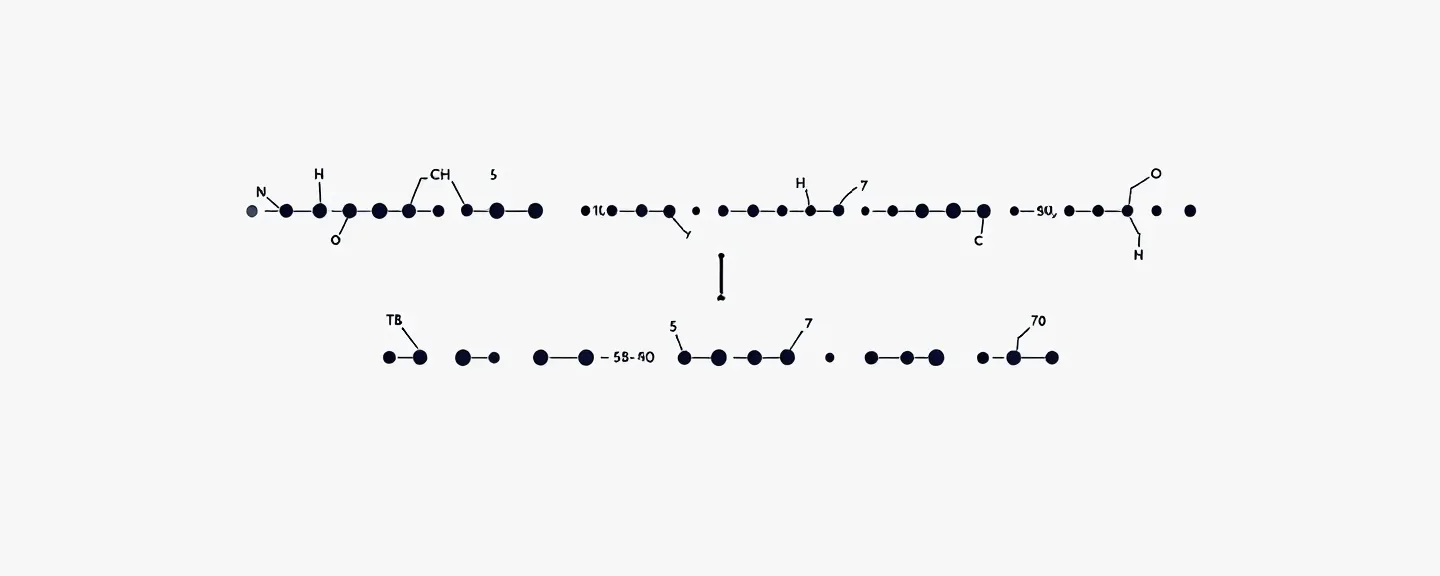
The Wolverine blend pairs two synthetic peptides. BPC-157 (Body Protection Compound 157) is a 15-amino-acid pentadecapeptide with the sequence GEPPPGKPADDAGLV — a fragment modeled on a cytoprotective protein originally isolated from human gastric juice in the early 1990s [1]. TB-500, as it is sold by research-chemical suppliers, is a synthetic 7-amino-acid N-acetylated fragment (Ac-LKKTETQ-OH) corresponding to residues 17 to 23 of the full 43-amino-acid peptide thymosin beta-4 (Tβ4) [9].
The seven-residue fragment carries the central actin-binding helix of Tβ4 — the LKKTETQ motif — but lacks the rest of the parent chain [22]. That detail matters, and we keep returning to it across the site, because most of the published efficacy data that gets attributed to TB-500 in marketing copy was actually generated with the full 43-residue Tβ4: the RegeneRx and HLB Therapeutics ophthalmic programs [13][14], the venous-stasis-ulcer Phase II [12], the Bock-Marquette cardiac papers [9][10], and the 2021 first-in-human Phase I [15]. A reader who treats TB-500 findings and Tβ4 findings as interchangeable will overstate the strength of the evidence behind the marketed fragment.
The two peptides are co-administered in the research-community vernacular because they act through complementary pathways: BPC-157 contributes a local angiogenic and cytoprotective signal at the injury site, while the TB-500 / Tβ4 fragment contributes an intracellular actin-sequestration signal that supports cell migration [16].
Why the nickname Wolverine, and why we set it aside
Wolverine is research-community shorthand for the rapid-healing phenotype that some forum users associate with the BPC-157 + TB-500 pairing. It is not a brand, not a trademark we have any license to use, and not a reference to any comic-book character. We treat the word as a search-term artifact — the name of a folk category — and prefer the body-copy descriptor BPC-157 + TB-500 research blend throughout the rest of the site.
This matters because animal-model evidence supporting the pairing does not, by any honest reading, justify cinematic claims about regeneration in humans. The compounds have been studied carefully in rats, mice, dogs, and a handful of small, uncontrolled human reports [6][7]. Calling that body of work a healing factor would be a misuse of language.
What the research actually shows
BPC-157 has been studied for thirty years in rodent injury models — tendon transection [1][3], muscle crush and surgical detachment [4][21], spinal-cord compression [20], gastrointestinal anastomoses [8], and ischemia-reperfusion of distant organs [26]. Across those studies, doses in the range of 10 μg/kg or 10 ng/kg given intraperitoneally, intragastrically, or in drinking water have produced functional and histological improvements [1][4][8].
For the full-length parent peptide of TB-500 — thymosin beta-4 — the human evidence is more developed. Phase II topical ophthalmic trials of RGN-259 (a 0.1% Tβ4 ophthalmic solution) reported a 35.1% reduction in ocular discomfort and a 59.1% reduction in corneal staining at day 56 in severe dry eye [13]. A multi-center Phase II in venous stasis ulcers reported an approximately one-month acceleration of complete wound closure versus placebo [12]. A first-in-human Phase I intravenous study of recombinant Tβ4 in 84 healthy volunteers reported no serious adverse events and dose-proportional pharmacokinetics [15].
For the combination specifically — BPC-157 paired with TB-500 — the answer is shorter. No controlled head-to-head or combination study has been published in a peer-reviewed journal that defines a synergy ratio, a combined dose, or a primary endpoint [6][16]. The pairing is mechanistically plausible. It has not been formally demonstrated.
The regulatory picture
Both BPC-157 and TB-500 (and the full-length thymosin beta-4 that the marketed fragment is derived from) sit outside the regulatory frameworks that govern approved medicines. The FDA's withdrawn-nomination record retains safety concerns for BPC-157 and the TB-500 fragment; removal from Category 2 through nomination withdrawal is not clearance or permission to compound [7].
BPC-157 is on the World Anti-Doping Agency Prohibited List under category S0 (Non-Approved Substances), explicitly named on the 2022 list and in force since 1 January 2022. TB-500 / thymosin beta-4 is prohibited under category S2 (Peptide Hormones, Growth Factors, Related Substances, and Mimetics). Both are prohibited at all times, in and out of competition. A 2024 Canadian Centre for Ethics in Sport case produced a four-year ineligibility for an athlete who had used the combination.
Readers looking for further detail on each of these points will find the relevant primary sources collected on the references page.
Read the evidence before the marketing
Every claim on this site maps to a numbered citation you can check yourself. Start with the mechanism, or go straight to the source list.